Diatomite is a friable light-colored sedimentary rock that is mainly composed of the siliceous skeletal remains of diatoms. It is a very porous rock with a fine particle size and a low specific gravity. These properties make it useful as a filter media, an absorbent, and as a lightweight filler for rubber, paint, and plastics. When diatomite is crushed into a powder, it is usually called "diatomaceous earth," or D.E.
What are Diatoms?
Diatoms are members of a large, diverse group of algae that drift freely in the waters of oceans and lakes. A few types of diatoms live on the bottom of these water bodies and in soils. Most diatoms are microscopic, but a few species are up to two millimeters in length. As a group, diatoms are unique because they are single-celled organisms that produce an external cell wall composed of silica, called a frustule. These frustules are very thin and have a delicate structure.
Nearly all diatoms are photosynthetic and live in water less than about thirty feet deep, where sunlight can penetrate. Diatoms are prolific and are responsible for producing nearly half of the organic mass in the world’s oceans. Their abundance and small size places them at the base of the marine food chain.
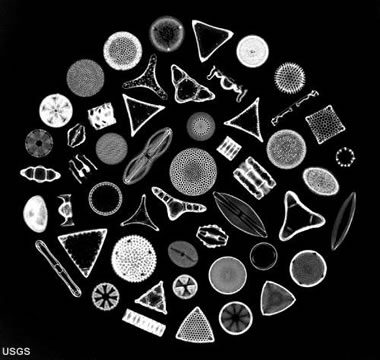
Diatoms: This image illustrates the frustules of fifty different diatom species. These organisms are microscopic in size, and many of their frustules are a network of tiny pores and openings. This characteristic is what makes diatoms a perfect medium for filtering tiny particles from fluids at water treatment plants, breweries, food processors, chemical plants, and other facilities. Their delicate structure is also a reason why they are very soluble. Image by the United States Geological Survey.
Diatom Ooze
When diatoms die, their siliceous frustules sink. In some areas the frustules are not incorporated into the bottom sediment because they dissolve as they sink or dissolve while on the sediment surface. If the sediment is composed of over 30% diatom frustules by weight, it would be called a "diatom ooze" or a "siliceous ooze." These are the sediments that are lithified into the rock known as diatomite.


