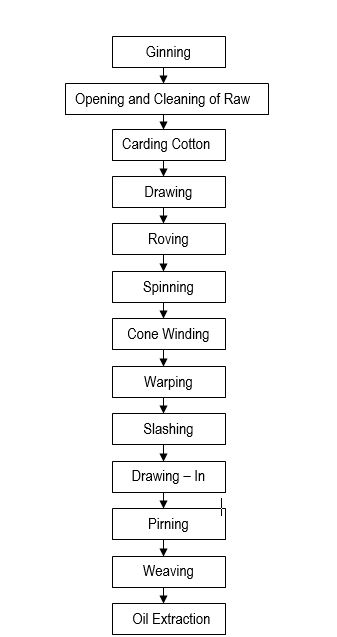
Textile manufacturing processes consists of a number of successive processes in each of which alternative technologies are available. Limiting consideration to the production of woven cloth, the following stages may be distinguished.
Ginning:- Ginning is the separation of seed from seed cotton and recovery of clean lint. The process requires a dryer, a gin saw or some other type of separation devices. The clean lint is then compacted and tied with a bale wrap. It is finally weighed and stored.
Opening and Cleaning of Raw Cotton:- The object of this process is to blend cotton so as to obtain uniformity, remove leaf dirt and fresh, open up the fibres after they have been compressed in the bale and deliver a clean uniform product in a suitable form to the next stage. Opening and cleaning process begins with the feeding of cotton, which may be manually or mechanically plucked from the bales, and ends with the scutcher, which either forms a lap (which is then either manually or mechanically doffed) or chute-feeds the material to the next stage. The modern opening line has a capacity of above 1,200 Ib/h (540 kg/h). The scutcher, 600 Ib/h (270 kg/h)
Carding:- In carding, the lap is attenuated into a sliver (about 100 draft) and the fibres made parallel for the next stage. The modern high production card is the most efficient machine, producing about 70 Ib/h (32 kg/h) with a 130-hp (98.kw) motor.
Drawing:- Drawing evens the sliver. The modern draw frame with a production of about 135 Ib/h (61kg/h) is more efficient than its predecessors. An alternative automatic model may be used if it is desired to proceed to open-end spinning omitting the moving stage. The small-scale frame for use in hand spinning has the usual capacity of about 2.5Ib/h (1kg/h).
Roving:- Roving further attenuates the sliver to above 7 draft. The latest model of roving spindle runs about 1300 revolutions per minute but a cheaper model of about 1000 rpm is also available.
Spinning:- There are two main types of spinning: ring spinning and open-end or break spinning. In ring spinning the roving is further attenuated by roller drafting to the fineness of the yarn required, usually a draft of about 20 and at the same time twist is applied to give the yarn the necessary strength Full bobbins may be manually or automatically doffed. The maximum speed of the spindle is about 15000 rpm. In open-end spinning the sliver from the draw frame is broken into its constituent fibres within the spinning vessel (rotor), which rotates at about 50000 rpm. Both systems may also be used in hand spinning, but speeds are lower, averaging about 4000 rpm and about 1200rpm respectively.
Cone Winding:- Cone winding facilitates subsequent processing by rewinding yarn onto a large package and removing faults. Three alternative machines are available all running at about the same speed of 1000 to 1250 yd /min (915 to 1140m/min) but differing widely in degree of automation from manual to advanced, which feeds ring tubes and automatically pieces up breakages. This stage is not necessary for hand spinning, which does not benefit from rapid processing and it is not strictly necessary in open-end spinning, since the spun package is already large enough.
Warping:- The warping step assembles the warp threads in a form suitable for sizing and drawing into the loom. The modern beaming machine is a high-capacity one that can handle about 7000 yd/h (5850m/h) but is more efficient than its predecessors. For hand weaving, machine of about 15yd/h (12.5m/h) capacity can be obtained
Slashing:- After warping the yarn is sized to reduce breakages at the weaving stage. The capacity of the modern slasher-sizing machine is about 3,500yd/h (3,200m/h) although a less efficient machine would be equally satisfactory if neither were used at full capacity.
Drawing – In:- The drawing-in of the sized warp threads through the heddles, reeds and drop-wires of the loom may be done either manually by a pair of workers drawing some 480 ends per hour or by one worker with a reaching-in-device, or automatically at about 1,200 ends per hour.
Pining:- The pirning operation consists of winding the yarn on to a package suitable for insertion in the shuttle of a loom. It is unnecessary for shuttleless looms or where direct spinning is possible. There is a choice between semi-automatic and automatic machines; the later having automatic feed. The small-scale hand-powered machine used for handlooms operation at about 80 yd/min (73m/min) compared with1,000 yd/min for power winding.
Weaving:- The main choice at the weaving stage is between shuttle looms and shuttle less looms. Shuttle looms range from handlooms through non-automatic power looms to automatic looms, the progression being towards more automated, labour-saving and capital-intensive machines. Within the automatic looms class there are a number of alternative models varying in speed and ease of operation. There are at present, three types of shuttleless looms: projectile (sulzer), repier and air jet. They are all considerably faster than the automatics and cost more, resulting in considerably lower labour-cost but somewhat higher capital requirements per unit of output. A complete manufacturing profile involves one technology from each of the stages. Outlined above so that the total number of possible profiles runs into thousands. To identify the lowest – cost technology it is necessary to combine capital and operating costs, and this involves a decision on the expected return on capital.
Oil Extraction:- After ginning, the seed is sent to a mill where it is cut or cracked and the hulls are separated mechanically from the kernels or meats. This is called decortication. The four major components of cottonseed in order of extraction are short fibres called linters (9%), hulls (24%), oil (16%) and cake or meal (46%). The meats contain oil and cake. The oil can be extracted either mechanically in a screw press or chemically with a solvent. After oil extraction, the cake contains about 41% protein


.jpg)


