Cassava is processed to reduce moisture content and hydrogen Cyanide levels. A description of some of the most common technologies is as follows
Chip Production
Chip production involves cutting peeled or unpeeled cassava roots into smaller pieces and allowing the pieces to dry. Sun drying is the most common and acceptable drying technique, while different types of chipping machines or choppers are used for cutting the tubers
Pellet Production
Production of pellets involves pressing chips and extrusion through a large die. The heat and moisture in the chips help in the formation of pellet like shaped product known as soft pellets. Later process developments involved grinding of chips followed by steam extrusion. This process produces strong pellets upon cooling. These types of pellets are known as hard pellets.
Cassava Starch and Flour Production
Starch production involves peeling and washing of the tubers followed by grating or mashing (also called pulverization) and then mixing the resultant mash with water.
The suspension is then sieved and the slurry sedimented. Water is decanted and the sedimented starch dried. Flour production involves peeling and washing the tubers. These are then cut into pieces and dried. The dried pieces are then milled and sieved. The resultant flour in this process is the unfermented flour. The fermented flour is produced by fermenting cassava through soaking or steeping the peeled and cut pieces of cassava in water. The fermented pieces are then dried before milling and sieving.
Modified Cassava Starch Production
Starch produced by the methods described above is known as‘native starch’. Modified cassava starches are produced to serve certain purposes for which native starch is not adequate.
Acid Modified Starch: This is obtained by reacting liquid native starch with hydrochloric and sulphuric acids. The process decreases the degree of sickness of starch. It also reduces the temperature required to convert the starch into gel. Acid modified starches are also called hydrolysed starches.
Oxidized Starch or Hypochlorite Modified Starch: This is produced by the process of oxidation when the native starch reacts with chloride (e.g. sodium hypochloride) in an alkaline (pH 8-11) medium. The derived starch will become less sticky with the degree of its stickiness depending on the amount of chloride used and the reaction time.
Dextrin: This is obtained when native starch is roasted in a drum under high temperature, while certain acids are sprayed to react with it. Dextrins are of different types namely: yellow dextrin, white dextrin and British gum. Dextrins are used in gumming operations such as glue and adhesives.
Alpha Starch or Cold-water-soluble Starch: This is obtained by a process called pregelitinization. In this process, liquid native starch in 40-50% concentration is drum dried. Starch is cooked and dried to form a thin crispy layer, which is latter ground and sifted to obtain fine powder. The fine powder becomes glue immediately on addition of water to it.
Starch Derivatives: These are processed starches whose molecular structures have been altered through chemical reactions e.g. starch esters (acetated starch, phosphoric acid ester) starch ether (carboxymethly ether and hydroxyethyl starch) and cross linked starch.
Ethanol Production from Cassava:
Cassava is first transformed to dried chips and the starch in the chips are initially hydrolyzed by liquefying enzymes (i.e. -amylase) and saccharifying enzymes (i.e. glucoamylase) to glucose, which is subsequently fermented to ethanol by yeast usually Saccharomyces sp. Recently, simultaneous saccharification and fermentation (SSF) method has been developed for the production of ethanol from cassava chips. In the SSF process, liquefied starch is hydrolyzed to glucose, which is immediately converted to ethanol by yeast at the same production stage. The ethanol produced by either process is recovered through distillation. The amount and quality of ethanol released and recovered depends to a great extent, on the efficiency of the enzymes used, the management of each stage, and the sophistication of the equipment used at each stage of the production process.
The process of flour production is described below.
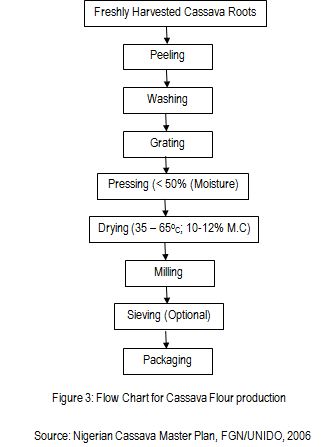
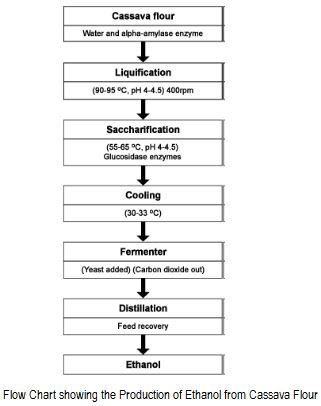
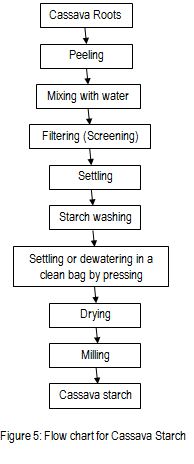
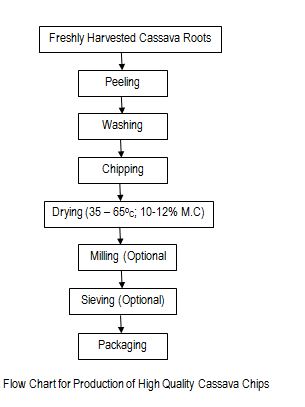
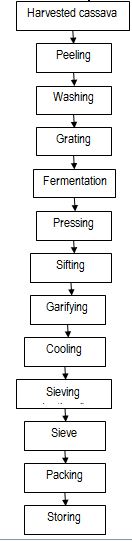
Above is Flow Chart for Gari
ESTABLISHMENT OF ONE HECTARE OF CASSAVA PLANTATION
Cassava, (Manihort esculenta) is a plant which grows well in many parts of the country, more importantly in the south western part. Products from this plant constitute a vital part of the daily diet of Nigerians and also a good ingredient in the formulation of cassava- based livestock feeds.
Cassava chips obtained from cassava tubers are preferred by some feed meal manufacturers in their formulations because of its high carbohydrate content. Specification of this cassava- based livestock manufacturers include moisture content (maximum) of 15.0%, fibre (maximum 5.0%) and sand (maximum of 3.0%) by weight. The pellet is highly used in Nigeria and overseas. The major products from cassava apart from chips are: garri, flour, fufu, starch and ethanol.
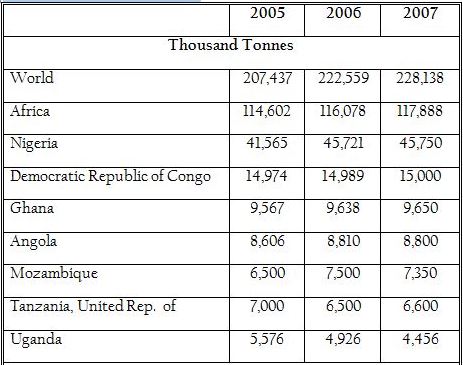
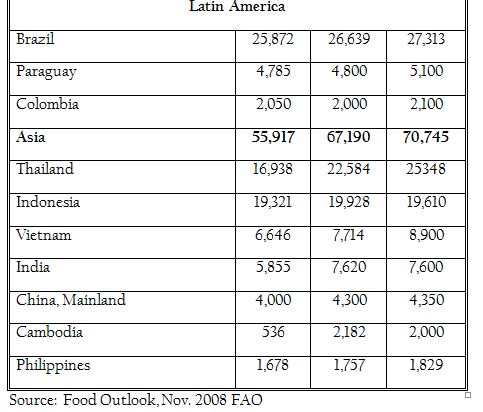
Production Levels of Cassava in Nigeria and Four of the world highest Cassava Producing Countries
.jpg)
World Cassava Production
Nigeria Cassava Producing Areas (Wet Tuber) by States (1998 – 2002)
|
State
|
1998
|
1999
|
2000
|
2001
|
2002
|
|
|
Area (000 Ha)
|
Production (000 Ton)
|
Area (000 Ha)
|
Production (000 Ton)
|
Area
(000 Ha)
|
Production (000 Ton)
|
Area
(000 Ha)
|
Production (000 Ton)
|
Area
(000 Ha)
|
Production (000 Ton)
|
|
Abia
|
83
|
1572
|
84
|
1572
|
83
|
1539
|
80.3
|
1593.1
|
84.2
|
1793.4
|
|
Adamawa
|
28
|
146
|
28
|
146
|
28
|
143
|
36.2
|
140.3
|
30.3
|
195.4
|
|
Akwa Ibom
|
87
|
901
|
88
|
901
|
87
|
882
|
87.5
|
893.2
|
85.6
|
904.0
|
|
Anambra
|
44
|
671
|
44
|
671
|
44
|
657
|
45.2
|
675.3
|
43.9
|
63.9
|
|
Bauchi
|
1
|
56
|
1
|
56
|
1
|
55
|
1.2
|
60.1
|
1.25
|
58.9
|
|
Bayelsa
|
29
|
331
|
20
|
331
|
29
|
324
|
30.95
|
576.87
|
31.53
|
513.94
|
|
Benue
|
226
|
3415
|
226
|
3415
|
225
|
3343
|
225.2
|
3340.4
|
230.6
|
2467
|
|
Borno
|
2
|
11
|
2
|
11
|
2
|
11
|
3.2
|
22
|
3.5
|
20.9
|
|
Cross River
|
140
|
1898
|
141
|
1898
|
130
|
1859
|
141.9
|
1859.5
|
140.8
|
1880.1
|
|
Delta
|
55
|
932
|
56
|
932
|
55
|
912
|
60.2
|
921.5
|
60.5
|
994.5
|
|
Ebonyi
|
89
|
1012
|
90
|
1012
|
89
|
991
|
60.2
|
776.2
|
60.3
|
789.9
|
|
Edo
|
59
|
783
|
59
|
783
|
59
|
767
|
60.2
|
776.2
|
60.3
|
789.9
|
|
Ekiti
|
37
|
817
|
37
|
817
|
37
|
800
|
39.2
|
804.5
|
40.1
|
854.1
|
|
Enugu
|
100
|
2475
|
101
|
2475
|
188
|
2423
|
189.1
|
2324.5
|
190.1
|
2465.0
|
|
Gombe
|
8
|
39
|
8
|
39
|
8
|
38
|
9.2
|
40.5
|
9.2
|
41.5
|
|
Imo
|
154
|
2123
|
155
|
2123
|
153
|
2079
|
172.67
|
2951.0
|
186.8
|
2940.5
|
|
Jigawa
|
5
|
13
|
5
|
13
|
5
|
13
|
7.5
|
25.2
|
7.6
|
24.8
|
|
Kaduna
|
83
|
826
|
84
|
826
|
83
|
809
|
85.3
|
890.4
|
84.3
|
884.0
|
|
Kano
|
4
|
11
|
4
|
11
|
4
|
11
|
5.2
|
19.4
|
5.2
|
18.9
|
|
Katsina
|
5
|
14
|
4
|
14
|
5
|
14
|
6.2
|
17.3
|
6.6
|
21.4
|
|
Kebbi
|
12
|
33
|
12
|
33
|
12
|
12
|
15.2
|
35.8
|
15.2
|
33.8
|
|
Kogi
|
151
|
2272
|
152
|
2272
|
150
|
2224
|
152.3
|
2434.3
|
152.9
|
4399
|
|
Kwara
|
9
|
833
|
9
|
833
|
9
|
816
|
11.2
|
861.3
|
11.0
|
856.7
|
|
Lagos
|
15
|
419
|
9
|
419
|
15
|
410
|
28.15
|
340.44
|
29.16
|
413.61
|
|
Nasarawa
|
40
|
722
|
40
|
722
|
40
|
707
|
12.83
|
144.21
|
|
879
|
|
Niger
|
99
|
766
|
100
|
766
|
99
|
750
|
101.7
|
870.5
|
101.7
|
1923.4
|
|
Ogun
|
98
|
1553
|
97
|
1553
|
98
|
1520
|
120.7
|
1840.0
|
126.7
|
1357.0
|
|
Ondo
|
74
|
1507
|
73
|
1507
|
74
|
1425
|
77.29
|
1354.12
|
77.60
|
1467
|
|
Osun
|
66
|
1190
|
67
|
1190
|
66
|
1165
|
87.6
|
1316.3
|
88.1
|
1459
|
|
Oyo
|
142
|
1530
|
143
|
1520
|
144
|
1496
|
90.29
|
1538.1
|
91.0
|
|
|
Plateau
|
40
|
589
|
40
|
589
|
46
|
577
|
23.5
|
290.06
|
|
2291
|
|
Rivers
|
191
|
2113
|
190
|
2113
|
193
|
2059
|
195.3
|
2296.3
|
195.2
|
16.8
|
|
Sokoto
|
3
|
9
|
2
|
9
|
3
|
9
|
4.5
|
10.2
|
4.5
|
974
|
|
Taraba
|
750
|
851
|
757
|
851
|
747
|
833
|
752.7
|
857.3
|
752.8
|
14.0
|
|
Yobe
|
2
|
12
|
2
|
12
|
2
|
12
|
3.2
|
15.0
|
3.1
|
126.8
|
|
Zamfara
|
9
|
24
|
9
|
24
|
9
|
23
|
11.7
|
132.1
|
10.8
|
120.8
|
|
FCT
|
11
|
225
|
11
|
225
|
11
|
220
|
15
|
819
|
10.5
|
|
|
TOTAL
|
3044
|
32691
|
3670
|
32596
|
30.28
|
32089
|
-
|
-
|
|
|
Source: PUC, Federal Ministry of Agriculture, Abuja
CASSAVA CHIPS/PELLET PRODUCTION
Cassava (Manihut esculenta) is a plant which is grown well in many parts of the country. Nigeria is well endowed with soil and climatic conditions that are suitable for planting of cassava. Nigeria is the world highest producer of cassava tubers with a total annual output of over 54millions metric tons per annum in 2012 (FIIRO, 2013). This has been achieved due to improvement in the yield of cassava varieties in Nigeria which led to this phenomenal growth in its production. Apart from the domestic processing of cassava into foods, cassava is industrially processed into many products such as chips, pellets and starch. Cassava chips and pellets are the acceptable form through which cassava can be exported. Cassava chips and pellets are used in producing many products such as ethanol, glucose, flour, livestock feeds, starch, biscuit, bread and adhesives. Cassava chips and pellets are in high demand internationally because they are part of the ingredient for the formulation of animal feed and a lot of foreign exchange could be earned from this product.
Cassava roots are highly perishable; with a postharvest life of less than 74hours. In order to reduce postharvest losses and increase its shelf life, cassava chips and pellet are the appropriate methods of preservation to ensure a steady availability of cassava throughout the year for cassava processors.
Cassava chips are unfermented white bride product of cassava with average diameter of 3mm-5mm, often used as carbohydrate base in the animal feed industry particular in Europe, or milled into flour for other uses such as in the production of ethanol, cakes, dough-nut and biscuits. Chips are the most common form in which cassava roots are preserved and marketed abroad.
Cassava pellets are produced from chips and broken roots by grinding and hardening into cylindrical shape. The pellets are about 2 - 3cm long and about 0.4 – 0.8cm in diameter and uniform in appearance and texture. Pellets have some advantages over chips: quality is more uniform, occupies less space, thus, reducing cost of storage, handling, transportation and arrives destination undamaged unlike chips.
Cassava chips and pellets are essential ingredients used for the production of animal feeds due to their high quality.
Carbohydrate Content in Cassava Tubers
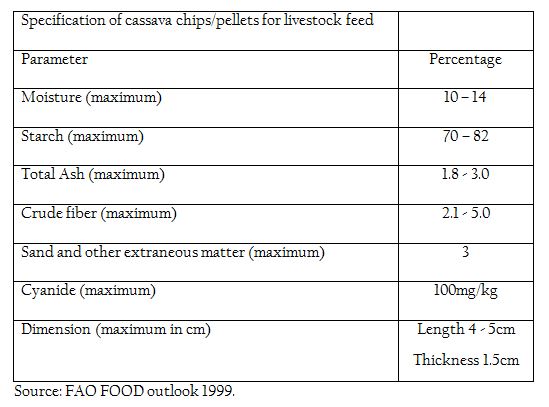
International price of chips and pellets fluctuate between USD1,200 - 1,300 per metric ton and the local price is N120,000.00 per metric ton. The percentage of moisture content, fibre, sand and starch depends on the feed miller’s specifications. Above is the specification of cassava chips/pellets for livestock feed.
Raw Materials
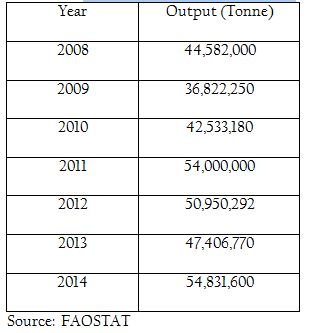
Cassava tubers are the only major raw material for this project. It is a tropical crop grown extensively in many parts of Nigeria especially in the southern and central states. Nigeria was the highest producer of cassava in the world with an output of about 54 million tonnes in 2012 (FIIRO, 2013). Table 1 below shows cassava production output between 2008 and 2012. Available species in the farm has yield of 3 - 4 tonnes per hectare. But high yielding species with 10 tonnes per hectare are available in some of our Agricultural Research Institutes. This could be collected by state government and distributed to farmers or the intending investors.
Output of Cassava 2008 - 2014
Process (Cassava Chips)
The process technology consists of the following simple basic unit operations:
Sorting and Weighing: The cassava roots delivered for processing are sorted, wholesome ones selected and weighed thereafter
Peeling: The roots are peeled manually or mechanically
Washing: The peeled roots are washed to remove dirt
Chipping: The washed roots are chipped into thin slices of desirable sizes
Drying: The chips are dried
Packaging: The chips are packaged in sacks ready for the market.
Production Process (Cassava Pellets)
The dried cassava chips are subsequently pulverized and later pelletized. However, cassava chips to be processed into pellets are never dried to the same moisture content as those to be processed into flour. This is to enable the pelletization process to be carried out. Pelletization is done with the help of pelletizing machine. The output could be varied from 12-20mm round pellets to squared pellets.
The process involves feeding dried cassava into the pelleting machine, followed by screening and bagging for export. Powdered chips spills are re-pressed into pellets and the process repeated. There is usually about 2 - 3% loss in weight during the process.
HIGH QUALITY CASSAVA FLOUR (HQCF) PRODUCTION FOR USE IN CONFECTIONERY PRODUCTS
Cassava flour is obtained from the tubers of the cassava plant (Manihot esculenta). Cassava flour is made from freshly harvested cassava tuber, peeled, and then using appropriate technology desiccated into fluffy powdery product.
Cassava flour is rich in starch and fiber. There are about 1550 calories in 1kg of cassava flour. The composition of cassava flour is approximately; 80.4% carbohydrate, 1.7% protein, 1.6% fat, 12% fiber, 0.19 water, and 42% minerals. The swelling powers of cassava flour range from 5.87% - 13.14%, water binding capacity varied from 113.66% - 201.99%, amylase content varied from 10.9% - 44.3%, gelatinization temperature within the range of 66.8oC – 70.4oC, peak temperature varying between 73.1oC and 84.52oC and cyanogenic potential ranges from 0.58 – 20.0mg. These physiochemical properties and pasting characteristics depends on the cassava variety.
Raw Material
The major raw material for the production of high quality cassava flour for the confectioneries is cassava tuber.
Nigeria is the world’s largest producer of cassava in terms of volume. However, it is ranked 8th in terms of yield (kg/ha) relative to such countries as Brazil and Thailand.
Uses of Cassava Flour
There are two types of cassava flour: fermented (lafun) and none fermented (high quality flour). Fermented flour is consumed directly as foods (such as lafun), while unfermented flour is used in bakeries and confectioneries.
As a component of African foods, cassava flour has found applications in the production of many products:
- It can be used more or less the same way as wheat flour and thus cassava flour is widely used in making the following products:
- Bread
- Biscuit
- Cake
- Doughnuts
- Pancake
- Spaghetti and noodles
- Cassava flour is an excellent thickener for gravies, stews and sauces.
- Those with irritable bowel syndromes or celiac disease have found it very useful to substitute cassava flour for wheat flour in their meals.
Market Potential
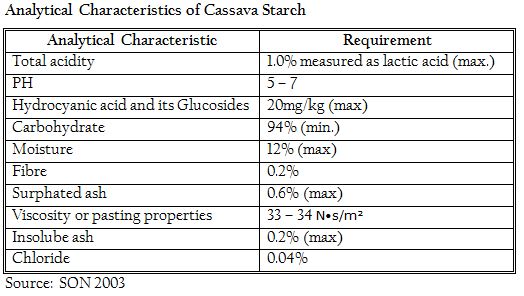
Cassava flour has the potential for multiple applications in the food industry. The market for cassava-based products is being explored both within and outside Nigeria. The International Institute for Tropical Agriculture (IITA) worked with Standard Organisation of Nigeria (SON) to develop and publish quality standards for all cassava products intended for export.
There are now increasing demand for cassava products to the extent that many countries of the world are now encouraging Nigeria to increase production level so as to meet their demand for industrial growth and development.
In many developing countries, bread, cake, biscuits, doughnuts, spaghetti and other flour based products consumption is continually expanding and there is increasing dependence on imported wheat. It would therefore be economically advantageous for these countries if importation of wheat could be reduced or eradicated and the demand of these flour- based products could be met by the use of domestically grown cassava instead of wheat flour.
The price of wheat in the international market has since 2003 been quite unstable and has significantly increased as well. This implies an increase in the draw on the nation’s foreign reserves.
In 2004, Nigeria imported 240,000 tonnes of wheat at an average price of $190 per ton. That cost the country a whopping sum of N45.6 billion.
If the 10% cassava inclusion in bread production becomes fully effective, the Flour Mill alone needs over 200,000 tonnes of cassava flour per annum. While a mix of 10% cassava flour with 90% wheat flour is seen as standard in countries where consumers have developed a taste for the later, experts postulate that the mix can be 30:70, thus, further cutting cost of skyrocketing wheat prices. Now is seen prudent to look at 30% mix, which means saving over N60 million in foreign exchange.
In 2006, it was estimated that the national demand for cassava flour for all purpose stood at about 2.8 million tonnes per annum. It was also estimated that the major flour mills in Nigeria needed about 200,000 tonnes of cassava flour if the 10% substitution of wheat flour with cassava flour was fully brought into effect. The anticipated rise in the price of wheat flour to about 39% then as announced by Nigerian Flour Mill (NFM) would have compelled Nigeria to look towards cassava as a viable alternative. The Nigerian consumers have not allowed this to happen.
There are ample investment opportunities in cassava flour production in Nigeria. The high demand for cassava-based foods has been on the increase both within and in some African countries.
The share of cassava utilization in food constitutes more than 80% of the total supply of cassava in Nigeria.
Considering the quantities of bread, biscuits and other cassava-based food products consumed in Nigeria, it is evident that there will be a very high demand for high quality cassava flour in Nigeria market.
It is estimated that more than 40 million tonnes of cassava would be needed to service different industries that are processing cassava into various products of which cassava food products takes 80%.
International trade on cassava and cassava products is dominated by the Asian countries, particularly Thailand, Indonesia, China, India and Vietnam. In the Latin America and the Caribbean, Brazil, Columbia, Venezuela and Paraguay are the major exporters. The major export markets are European Union and United States and the major product in trade are mainly pellets, chips and starch.
To capture these markets, Thailand Industrial Standards for cassava products could be adopted as a benchmark for cassava products in the international market. The standard prescribes requirements, packaging and marking methods for sampling and analysis for cassava products.
Cassava flour must conform to these requirements, moisture (10%), crude fiber (2%), sulphate ash (0.6%), total acidity (1.0%), carbohydrate (85%) and cyanic (10%).
Colour of the cassava flour should be white to light green, free from adulterant, undesirable odour and insect infestation.
Cassava flour shall be packed and stored in containers which will safeguard the hygienic and organoleptic qualities. It should also protect against bacteria, insect, fungi and other contaminants. The packaging materials shall also protect against infiltration of moisture and leakages, and should not impact any odour, taste, with name of product, net weight, name and address of manufacturer, country of origin, date marking and NIS certificate mark. Other requirements to be noted are maximum residue limit for pesticide, metallic contaminants level and other recommended parameters.
Sourcing of cassava as a major raw material for the business is not expected to be a problem.
Major Equipment
The major equipment for producing high quality cassava flour include extruders, millers peelers, washers, graters, pressers, flash dryer, milling machine and packaging equipment.
Process Technology
The cassava tubers are peeled, washed, grated, pressed, extruded, milled, dried and packaged. The farmers will be monitored to make sure that matured (but not over matured) tubers are processed. They will also be monitored to make sure that all operations from uprooting to pressing and transporting to the centre are completed within 18 hours. This is to ensure that all operations including drying are completed within 24 hours.
At the centre, pressed cake will be loaded into the dryer and dried within specific time in accordance with the instructions by the equipment manufacturer so as to obtain high quality product.
The dried flour will be milled according to the particle size and other specifications of the end users.
Capacity
The capacity of the equipment is 2.5MT/day but this Profile will be based on 80% capacity, producing at 2.0MT/day of flour or 600 tonnes/annum.
CASSAVA STARCH PRODUCTON
Market Potential
Industrial cassava starch finds wide application in the food processing industry for the production of jellies, glucose, sweeteners, baby foods, custards and confectioneries, in the pharmaceutical industries, in the production of cosmetics, toiletries, tooth paste, face and baby powder, in the paper and card board industries, in the production of glues and adhesives; in the sizing of textiles laundry purposes and in the manufacture of batteries. There is wide and diverse market for industrial starch in Nigeria.
Production Process
- Weighing, peeling and washing in a cylindrical washer tank.
- Rasping and grating
- Pulp is screened into various grades of pulp
- Settling and sedimentation of starch granules
- Drying
- Milling to flour
Machinery and Equipment
Peeling machine, grater, rotary screening machine, settling tank or starch table, drying and weighing machines.
Production Capacity
This profile envisages to process 10,000MT of raw cassava to produce 2,000MT of starch per annum respectively.


.jpg)


