Mango Processing (Pulping and Juicing)
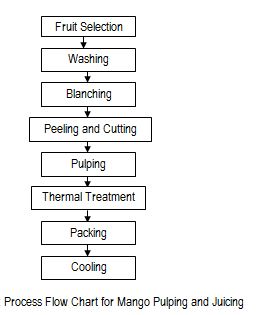
Fruit Selection
Matured fruits with uniform colour and texture, minimum soluble solids of 13 ° Bri, pH value of 3.5 to 4.0, devoid of insect infestation and mechanical injury are preferred. The receiving area must be clean, well ventilated, and free of insects, rodents or other animals. It is not advisable to hold the fruits too long before processing to avoid spoilage.
Washing
The washing pit should be filled with water containing 15 ppm chlorine in order to reduce microbial load and impurities from the fruit. A second washing with clean water is made to eliminate residual chlorine.
Blanching
This operation is done to inactivate enzymes, eliminate air inside the fruit tissues, remove off-flavours and aromas, fix fruit colour and soften the tissues for further pulping. Two methods are currently used to effect blanching: dip in boiling water or direct steam injection. The thermal treatment is applied such that internal fruit temperature reaches 75°C. This usually requires 10 minutes in boiling water, or 6 minutes with steam. Fruit is blanched unpeeled.
Peeling and Cutting
Pulp is separated from the seed manually with knives made of stainless steel, on a working bench. Mango pieces are placed in clean plastic containers and taken to the pulping machine.
Pulping
Mesocarp pieces are passed through a fine mesh to remove undesirable particles. After pulping, a smooth puree is obtained. Recommended mesh size is 0.5 mm. coarser material is separated in the process and disposed properly. The pulp is transferred in containers to the kettle
Thermal Treatment
A heat treatment is applied in the kettle to prevent chemical and microbial spoilage. In this treatment the pulp reaches 95°C and is held for 10 min. with continuous stirring.
Additives
The use of additives is recommended to extend the pulp shelf life. Commonly used additives include 0.39 percent citric acid to decrease pH and prevent microbial growth and enhance effectiveness of preservatives as sodium benzoate (0.5 percent).
To prevent discoloration 0.1 percent ascorbic acid is used as antioxidant. Additives are incorporated to the pulp right before the thermal treatment is finished (ca. 5 min before) by dispersing in hot water or pulp and proper stirring. Final product should have 13 °Brix and pH values between 3.4 to 3.5.
Packing
The pulp is packed when hot in plastic containers, sealed immediately and flipped over so the internal part of the lid gets in contact with the hot product. All packing materials must be clean before used.
Cooling
Hot containers are cooled with fresh water at the lowest temperature attainable. After cooling, lid closings should be inspected. Finally, containers are cleaned and labels affixed to be sent to a fresh, clean storage place as depicted in figure 16.
Specification of Alphonso Mango Pulp
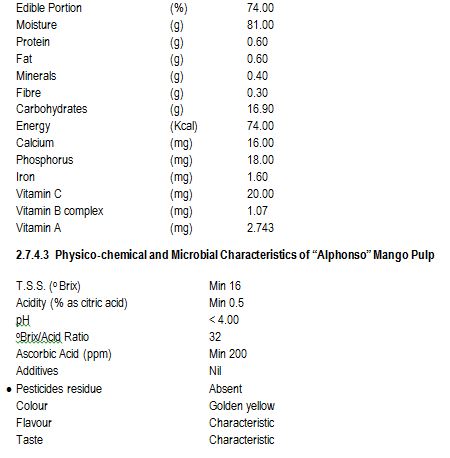
Physical, Chemical and Organoleptic Characteristics
- T.S.S. (° Brix) Min 16
- Acidity (% as citric acid) Min 0.5
- pH < 4.00
Mango pulp is perfectly suited for conversion to juices, nectars, drinks, jams, fruit cheeses or to be eaten with cream as a superb dessert. It can also be used in puddings, bakery fillings, and fruit meals for children, flavours for food industry.
Proximate Composition of Alphonso Mango variety is cultivated in Adamawa, Gombe, Borno etc.
Microbial Characteristics
- T.P.C CFU/g < 50
- Yeast CFU/g < 50
- Mould CFU/g < 10


.jpg)


