Cashew can be processed into the following products:
- Cashew apple used in the production of jam, chutney or various beverages, wine and juice.
- Cashew Nutshell Liquid (CNSL) used as resin modifier, and as filler in brake lining, and manufacture of paints.
- Cashew Gum processed for pharmaceutical use and as substitute for Gum Arabic.
- Cashew Kernels processed into snacks, edible oil, confectionery etc.
Cashew kernel is the most valuable, and the main objective of processing is to remove the kernel from the shell with as little damage as possible. Technologies used for processing each product are essentially different, as described below:
Processing of Cashew Apple into Wine
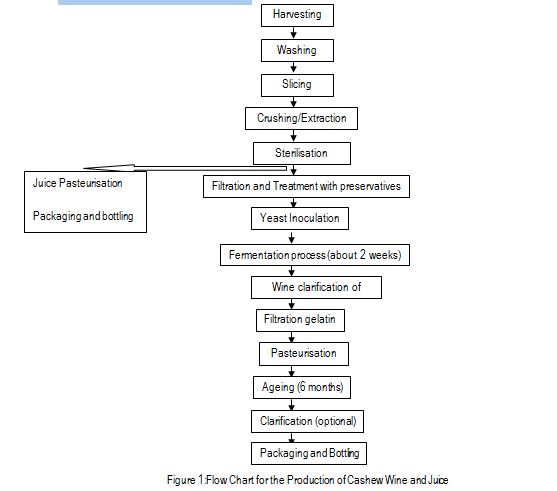
The flow chart for the production of cashew wine and juice is shown in Figure 1. The washed cashew apples are cut into slices in order to ensure a rapid rate of juice extraction. After slicing, the apples are crushed in the juice press. The fruit juice is sterilized in stainless steel pans at a temperature of 85oC in order to eliminate any wild yeast. The juice is filtered and treated with preservatives. At this stage, the juice can either be pasteurized and packaged as cashew juice, or wine yeast (Saccharomyces cerevisiae) can be added for cashew wine production. Once the yeast has been added, the juice is thoroughly stirred and allowed to ferment for about 7-14 days. The wine is separated from the sediment and clarified by mixing refining agents such as gelatin, pectin or casein. After filtration, the filtered wine is transferred to wooden vats. The wine is pasteurized at 50-60oC. Above 70oC, the alcohol vaporizes. The wine is stored in the wooden vats and subjected to ageing. At least six months should be allowed for ageing. If necessary, the wine should be clarified again before bottling.
Processing of Cashew Nut into Cashew Kernels
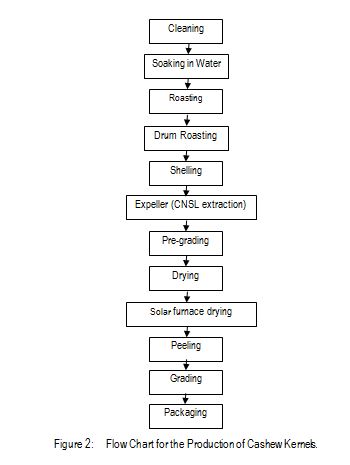
The processing of cashew nuts into kernels consists of seven main steps:-
- Cleaning and sizing
- Roasting and centrifuging
- Shelling: Removal of the outer shell and CNSL.
- Peeling: Removal of the testa
- Grading: Sorting into different sizes and colours in accordance with standard grading
- Drying or humidifying:- To a final moisture content of 5 percent.
- Packing: Into airtight bags or cans.
A general overview of the process is summarized
CASHEW NUT PROCESSING
Cashew nuts are actually the kidney shape seeds that adhere to the lower part of the cashew apple, the fruit of the cashew tree. Whether roasted, salted, sugared, pepped or covered in chocolate, the cashew nut, often used as flavor and complements to main dishes and desserts, contains a mix of nutrients and minerals not commonly found. Cashew nuts do have a relatively high fat content (12 grams per ounce of 2 grams saturated fat), but it is considered “good fat.” This is due to the agreeable fat ratio in the nut, 1:2:1 for saturated, mono-unsaturated, and poly-unsaturated fats, respectively, which scientists say is the ideal ratio for optimal health.
Cashew nuts also have a fatty acid profile that contributes to good health through phytostererols, tocophenols and sqaulene, all of which lower the risk of heart disease, combined with the nut’s zero percent cholesterol content.
Even with the relatively high fat content, cashew nuts are considered to be a “low fat” nut. In fact, cashew nuts contain less fat per serving than many other popular nuts commonly found in grocery stores and health food stores, including almonds, walnuts, peanuts and pecans.
Recommendations vary for cashew nut consumption in diet and weight loss. Cashew nuts have a high energy density and high amount of dietary fiber which have been attributed to a beneficial effect on weight management.
Nutritive Value and Composition
Cashew is a highly nutritious and concentrated form of food, providing a substantial amount of energy. The kernel has a pleasant taste and flavor and can be eaten raw, fried and sometimes salted or sweetened with sugar or honey. It also serves as an important source of invisible fat in the diet, being widely used in a variety of ways. There has been a growing demand for cashew nut in many temperate countries where the demand is increasing. The nut contains an acrid compound which is a powerful vesicant that is abrasive to the skin. The cashew shell contains 25% of this reddish brown oil, industrially known as Cashew Nut Shell Liquid (CNSL) which is a by-product of the roasting process.
Overall Composition
The kernel is considered to be of high nutritive quality and growing conditions or the variety of cashew may have an influence on kernel composition. The overall composition of the kernel is protein 21%, fat 46% and carbohydrates 25%.
Total Nutrient Content
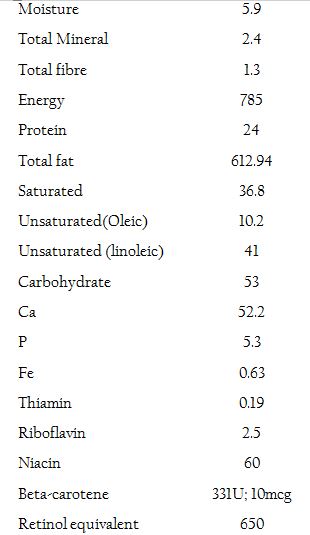
The total Nutritive value of 100g of cashew nut is presented in Table 1
Nutritive Value in 100g of Cashew Nut
Vitamin K
Fatty Acid Composition
The fat and oil contents of cashew nut kernels contributes substantially to its energy content and consists mostly of glycerides of oleic acid (73.8%) and linoleic acid (7.7%)
Fatty Acid Composition of Cashew Kernels (%)
|
Oleic
|
73.3
|
|
Linoleic
|
7.67
|
|
Palmitic acid
|
0.89
|
|
Stearic acid
|
11.24
|
|
Lignoseric acid
|
0.15
|
|
Unsaponifiable matter
|
0.42
|
Source: FAO Regional Office for Asia and the Pacific (2007)
Vitamin Content
The vitamin content of cashew nut kernel is 0.5 - 1.4mg per 100g of thiamin and 0.58mg per 100g of riboflavin. A good proportion of vitamin E and traces of other vitamins are also present in cashew nut.
Market Potentials
Nigeria's supply of raw cashew nuts is generally considered lower in price compared to the prices of other African producers notably Benin, Tanzania, and Guinea Bissau. Hence, two major buyers from India and Vietnam export whatever supply is available in the country. A smaller quantity of Nigerian nuts mixed with those from Benin is sold at a higher price.
However, Nigeria has the potential to capture US and European markets for kernels in the future. For this, Nigeria's processing industry has to focus on adapting to international quality standards, good handling practices, improved working conditions and other internationally recognized best practices. However, the country has a substantial local market, significantly large to support the local processing industry. Nigeria already exports cashew kernels of about 1000 tonnes a year. Investors are encouraged to key into cashew kernel production in the near future so as to attract foreign exchange for the country.
Raw Materials
Cashew grows almost everywhere in Nigeria but a major part of the existing plantations are concentrated primarily in the Southern and North Central zones of the country in small sized plantations. At present, of the total cashew plantations, about 60% are still considered as wild, 20% as rehabilitated and the remaining 20%, new commercial plantations, some of which are yet to proceed tothe production phase. The existing plantations are spread over mainly in 15 - 18 States namely: Kogi, Kwara, Plateau, Anambra, Abia, Imo, Enugu, Ebonyi, Taraba, Bauchi, Kano, Kaduna, Edo, Cross River, Oyo, Ogun andOndo.
Cashew nut production has been growing steadily from 30,000 tonnes in 1990 to 636,000 tonnes in the year 2006 (FAO, 2007). The yield per hectare has also increased from 600 tonnes in 1990 to 1,990 tonnes in 2006 (FAO, 2007)
Production Process
Cleaning and Sorting: Raw cashew nuts are first cleaned and sorted out from waste and unwanted materials.
Drying and Warehousing of Nuts: The cleaned and sorted raw cashew nuts are graded into batches based on size.
Steam Boiling and Cooling: The raw cashew nuts are steamed under high pressure. The steam boiler and cooker are used to generate steam and cook the raw cashew nuts. Water is poured into it through an opening by the side of the pot. Water is allowed to boil to 100oC to generate enough steam, the raw cashew nut is poured into the pot to cook for 40 minutes. The boiler is dual- purpose built, serving as a steam generator and cooker. It also uses dual purpose sourced energy. It can be powered by naked fire or electricity.
Air Drying: The steamed nuts are dried to make shell brittle and easy to crack.
Shelling: The steamed cashew nuts will be shelled the second day using semi-mechanized cashew nut shelling machines.
Oven Drying: The kernels are then peeled. The thermal shock makes peeling easier when used to shock the semi-dried kernels. This method injects hot steam into the kernels that had been dried in the oven for five hours. This system further facilitates the peeling of the kernel. The steam will then be released into the chamber for ten to fifteen minutes. The kernel will be brought out to allow for cooling before further drying in the oven for another five hours.
Roasting and Cooling: The peeled kernels are roasted and cooled. There are two types of roasting pots, the electricity- powered and gas-powered roasting pots. The deep roasting pot facilitates oil roasting of the kernel, faster and uniformly. The cooling hanger comprises of 20 stainless trays where the hot kernel will be spread to allow cooling naturally before packaging.
Sorting: The kernels are then sorted and graded (sized, wholes, butts, and white, scorched).
Packaging: The kernels are finally carbon dioxide - flushed and vacuumed packed in 25lbs bags (2 to a carton). The machine has a hopper where the roasted kernel will be poured and the finished product is ready for market.
MACHINERY AND EQUIPMENT
- Steam boiler (stainless).
- Cashew shelling machine.
- Stainless peeling and grading machine.
- Cashew dryers.
- Scale for weighing raw cashew nuts.
- Bowls and knives for peeling and shelling of the cashew nuts
- Frying pot.
- Roasting mesh.
- Spiced nut stainless hangers.
- Packaging machine.
CASHEW BREAD PRODUCTION
Bread is a stable food in Nigeria. It has been hitherto produced from wheat flour, which serves as the major ingredient. Research has shown that cashew nut or cashew nut flour can be added to bread to increase its nutrient content. Cashew nut is a highly nutritious and concentrated form of food, providing a substantial amount of energy. The nut has a pleasant taste and flavor and can be eaten raw, fried and sometimes salted or sweetened with sugar. It also contributes as an important source of invisible fat in the diet.
Nutritive Value and Composition
Cashew nuts have a fatty acid profile that contributes to good health. The nut contains phytosterols, tocopherols and squalene, all of which lower the risk of heart disease. The nuts also has zero percent cholesterol content.
In spite of its relatively high fat content, cashew nuts are considered to be a low-fat nut. In fact, cashew nut contain less fat per serving than many of the other popular nuts commonly found in grocery and health food stores, including almonds, walnuts, peanuts and pecans. Recommendations vary for cashew nuts consumption in diets and weight loss. Cashew nuts have a high energy density and high amount of energy dietary fiber, both of which have been attributed to have beneficial effect on weight management.
Fatty Acid Composition
The fats and oil contents of cashew nuts kernel contribute substantially to its energy content and consist mostly of glyceride of oleic acid (73.8%) and linoleic acid (77%).
Market Potential
Food items like bread have a very wide market in both urban and rural areas. The bread industry is a viable venture considering Nigeria’s large population of children, students and adults with appetite for bread. They form the bulk of the customers. The market distribution network for bread is widely spread from urban to rural areas. The market would continue to increase as people gained satisfaction with the product.
The inclusion of cashew nut into bread production is an added advantage on health grounds. Cashew nut is a highly nutritious and concentrated form of food, providing a substantial amount of energy
Raw Materials
The raw materials for cashew bread production include: Cassava flour, wheat flour, cashew nuts butter/fat, yeast, preservatives, flavor, improvers, salt, sugar, eggs etc.
Production Process
The required quantities of raw materials are normally weighed as follows:
- Wheat flour - 90%
- Cassava flour - 10%
- Yeast - 0.5 - 0.8%
- Salt - 1.1 - 1.5%
- Sugar - 12 - 14%
- Water - 40 - 45%
The whole mixture is prepared into a paste which involves addition of water into the flour and mixing till smooth paste is obtained. This is followed by kneading in the rolling machine. Bread moulding process involves cutting the ductile paste into bread moulds. The moulds are set on rack, fed into hot oven and left to brake for a definite time. When the bread is done, the moulds are taking out of the oven and cooled. After cooling, the breads are parked and ready for sale.
MACHINERY AND EQUIPMENT
- - Mixer
- - Kneading machine
- - Oven rack
- - Weighing Scale
- - Quality controlled Equipment
- - Cutters
RODUCTION CAPACITY: 1,080,000 pieces per annum



.jpg)


